
Author’s note: Since the post below was published, a panel of three federal judges in Alabama has ruled that the congressional district map that the state of Alabama proposes to use in the 2026 midterm elections cannot be used because it racially discriminates against black voters. That is essentially the argument I make in the post below: A map that purports to cure a racial gerrymander favoring black Democratic voters in two Alabama districts is itself a racial gerrymander further benefiting an entrenched white Republican majority across the state. Also occurring since this post was published: The South Carolina Senate declined to heed Donald Trump’s call for a congressional redistricting in the state that would have threatened the state’s sole Democratic seat in the U.S. House, that held by the venerable James E. Clyburn, whose endorsement of Joe Biden in 2020 was the most important factor in Biden’s winning the Democratic Party’s nomination for the presidency.
——–
Donald Trump is in a hurry, and that is because knows he is in a race against three clocks: two electoral and the mortal. One electoral clock is counting down to the midterm elections in November, and the other is ticking toward the constitutionally mandated end of his presidency on Jan. 20, 2029. The mortal clock — his individual life clock — is, of course, counting down to the natural end of his existence as a pestilence. He will turn 80 years old on June 14 and looks increasingly decrepit — see, for instance, his “cankles”; the angry blister that lives behind one of his ears; the ugly blotch on the back of his right hand that he covers (badly) with makeup; and his unsteady gait. And his mind is clearly a mess and declining.
But Trump has big objectives to attain in a short time. And, for the moment, Fortuna seems to be smiling kindly in his general direction.
On May 15, the U.S. Supreme Court ruled against the state of Virginia in the state’s appeal of a Virginia Supreme Court ruling that found Virginia had violated its own constitution by holding a referendum on redrawing its congressional map. That referendum, which Virginia voters passed fairly narrowly, was intended to advantage Democrats as a response to irregular congressional redistricting in a number of Republican-led states at the urging of none other than Trump himself.
The defect in the Virginia redistricting effort lay in the timing of the process. For general edification, here is the key portion of the Virginia Supreme Court’s decision, issued on May 8:
“On March 6, 2026, the General Assembly of Virginia submitted to Virginia voters a proposed constitutional amendment that authorizes partisan gerrymandering of congressional districts in the Commonwealth. We hold that the legislative process employed to advance this proposal violated Article XII, Section 1 of the Constitution of Virginia. This constitutional violation incurably taints the resulting referendum vote and nullifies its legal efficacy.”
On May 10, the U.S. Supreme Court cleared the way for the state of Alabama to use a congressional district map that would effectively eliminate one of the state’s two majority-black districts. Rep. Shomari Figures, a Democrat representing Alabama’s 2nd Congressional District, can expect to be ousted in the midterms in November under the map that the U.S. Supreme Court’s ruling allows the state to use.
On the strength of the court’s ruling on the Alabama issue, Tennessee and Florida also are moving swiftly to use congressional maps that are likely to reduce black Democratic representation in Congress from those states.
This flurry of activity follows directly from another Supreme Court ruling in a case titled Louisiana v. Callais. Here is the essence of the high court’s holding in that case — a decision, delivered on April 29, that significantly weakens the landmark federal Voting Rights Act:
“Because the Voting Rights Act did not require Louisiana to create an additional majority-minority district, no compelling interest justified the State’s use of race in creating SB8, and that map is an unconstitutional racial gerrymander.“
Basically, the high court cleared the way for Republican-controlled state governments to attack congressional districts in their jurisdictions that are majority-black (and majority-Democrat, given historical patterns). Left unaddressed is the plain fact that a map redrawn to eliminate a racial gerrymander that benefits black Democratic voters is, in its practical effect, a racial gerrymander that further entrenches the power of white Republican voters.
Recent primary elections in various Trump-backing states have delivered more gifts to Trump. In Indiana, several Republican state senators who had helped to defeat a Trump-inspired congressional redistricting effort were themselves defeated in primaries.
In Kentucky on May 19, U.S. Rep. Thomas Massie, a Republican and Trump antagonist who broke decisively with our crooked president, was defeated in the GOP primary by the Trump-endorsed candidate Ed Gallrein.
As the New York Times reported that day, Massie “voted against Mr. Trump’s tax-cut bill, denounced the war in Iran and insisted on the release of the Epstein files over the president’s angry objections. Such apostasies, as the president put it in a video released the day before the primary, qualified Mr. Massie for the distinction of ‘the worst congressman in the history of our country.'” Goodbye, Tom. I salute you for finally finding the courage to stand up to Trump despite the cost, unlike the other cowards and enemies of American democracy in your party.
In Louisiana on the same day, Republican U.S. Sen. Bill Cassidy lost his re-election primary badly. He voted to convict Trump in 2021 in the Senate trial concerning the president’s role in the Jan. 6 attack on the U.S. Capitol.
In Georgia that day, Secretary of State Brad Raffensperger was defeated in the Republican primary for governor. The Republican primary will be resolved in a contest between two candidates, neither of them named Raffensperger. Raffensperger is the secretary of state in Georgia whom Trump telephoned in December 2020 asking him to “find” a specific number of votes that would negate Joe Biden’s election victory in the state and enable Trump to be corruptly declared the winner in the presidential contest there. Raffensperger politely declined, thus becoming a mortal enemy to Trump, in Trump’s eyes.
But Republicans should know that every transgression they commit in their quest to knobble our democracy is a precedent set that can be seized upon by others in the future. I fear that by their dishonest redrawing of congressional maps in defiance of the decennial norm, they have consigned that orderly traditional process to the ash heap.
In the field of election-fixing and political retribution, things look to be coming up roses for Trump. His lapdog Justice Department has even brought a new criminal case against former FBI director James Comey, after failing previously.
Where plain old corruption is concerned, our coin-operated president also shines. And once again, his obedient Justice Department has a hand in a disgraceful turn of events. The government that Trump leads has contrived to enter a settlement to end a Trump lawsuit against an agency that Trump oversees by creating a fund of $1.776 billion (in this, the nation’s 250th year, the “1776” is not accidental) to pay compensation to people supposedly improperly targeted for prosecution under the Biden administration. In exchange for the creation of this fund, Trump is dropping the $10 billion lawsuit that he filed against the IRS, of which he is the boss as president. The lawsuit the president filed issued from an IRS contractor’s leaking of Trump’s tax returns during the first term of our Trump nightmare.
Who will benefit from what is undoubtedly a slush fund? Trump’s allies, of course. A memo that the Justice Department sent to Republican senators on Capitol Hill explaining the fund says this: “There is no partisan restriction: Democrats can submit claims, too.” I would say that that declaration of nonpartisanship is a mere nicety. This money is meant to flow into Republican pockets to shore up the president’s standing with his base before the midterm elections. And the most obvious intended beneficiaries are the many hundreds of miscreants who were haled before the federal courts to answer for their criminality at the U.S. Capitol on Jan. 6, 2021.
But Trump might not get away with this trick so easily. Two former officers of the U.S. Capitol Police are suing to ensure that none of the money goes to anyone who was criminally convicted — that would include people who pleaded guilty and avoided trial — for having any role in the Trump mob’s brutal assault on the Capitol. Those former officers are not alone; lawsuits intended to kill this dirty fund are multiplying. In addition to congressional democrats’ denunciations of this corruption, we see growing opposition to it among Republicans in Congress. Among them: Senate Majority Leader John Thune, who has said, rather delicately, that he is “not a big fan” of the fund, according to a BBC report; and Rep. Brian Fitzpatrick of New Jersey, who worries that money from the fund will go to people who attacked the Capitol on Jan. 6.
Is this “1776” fund finally a bridge too far for Republican lawmakers being asked to carry water for Trump? Are more Republicans in Congress finally developing a conscience about the evils of the Trump administration? We can only wish.
Elsewhere, Trump continues to push at least one other truly diabolical scheme. The New York Times reported on Monday, May 18:
“President Trump moved ahead on Monday with plans to allow 10,000 more white South Africans into the United States as refugees, even as the program remains closed off to people from every other country in the world.
In a report submitted to Congress on Monday, Mr. Trump has proposed lifting the record-low refugee admissions level of 7,500 to 17,500, reserving the additional openings for Afrikaners, who are primarily of Dutch descent.
The administration argued that an ’emergency refugee situation’ in South Africa warrants the expansion of Mr. Trump’s carve-out for Afrikaners, which has reoriented the U.S. refugee program into essentially a pipeline for members of a white minority to reach the United States.”
Not since the violent and ugly death throes of Jim Crow in the 1950s and into the ’60s has the United States seen such a distillation of the racist energy that has surged and pulsed beneath the veneer of democratic and constitutional order here. The advent of the Obama presidency released this wild and desperate energy into a crisis of reactionism that has reached its apogee under the Trump administration.
No one should be in any doubt about what Trump is doing with this false-refugee plan. He is importing a white population that is steeped in the racism of apartheid to further strengthen the Ku Klux Klan mindset that is already strong in this country. What better population exists for the purpose than the descendants of the Boers who created apartheid, descendants who feel aggrieved that they are no longer hegemons in South Africa? They have not been materially dispossessed, but they have been relieved of the political power they wielded so cruelly over th country’s black population, and that is enough to make them beloved of Donald Trump. They are his natural constituency.
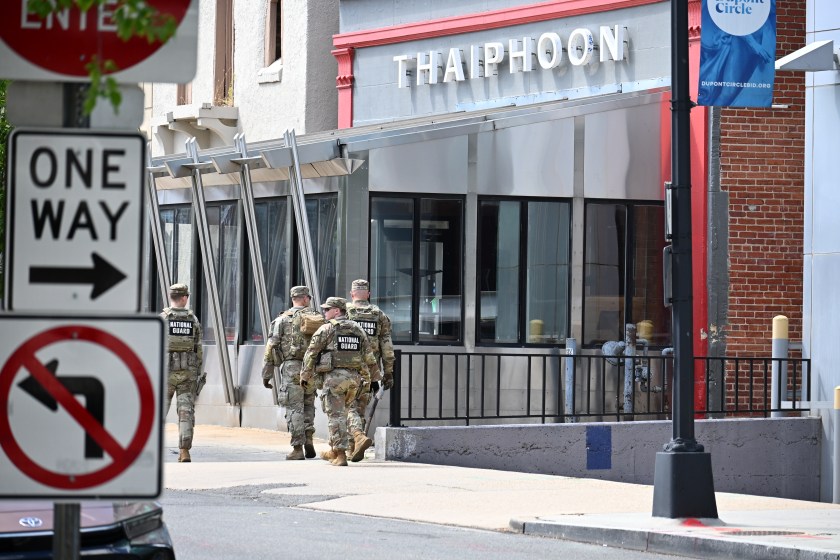
In all of this, Trump knows that he is doing evil work, and he fears that a segment of the American populace might successfully do to him what his mob tried to do to American democracy on Jan. 6. Thus you now see the White House permanently ringed with crowd-control fencing. Members of the public no longer can enter Lafayette Park on the north side of the White House, let alone reach the regular fence surrounding the People’s House as they were able to do normally for decades. Thus you see the National Guard’s deployment in the nation’s capital being extended from a temporary stay summer through to the scheduled end of Trump’s presidency in January 2029. Trump wants to ensure that at a critical moment, the National Guard forces in and around Washington will be answerable to him only and will be a shield for him. is afraid of the people.


It seems to me that only the national electorate acting in November can save American democracy now. I believe totally that Trump’s intention is to end it. But he isn’t there yet, and he can be stopped — if only more people will take an interest in our country’s future. Whenever I turn to contemplating the enthusiasm of the forces of darkness and the indifference of “good” people, my mind returns to a grim declaration in the Irish poet William Butler Yeats’ 1919 work “The Second Coming”:
“The best lack all conviction, while the worst are full of passionate intensity.”
That poem ends with these dark words:
“And what rough beast, its hour come round at last, slouches towards Bethlehem to be born?“
We voters who love American democracy, e its manifold imperfections, are the ultimate guarantors of its preservation. But we must pay attention. We cannot slumber when the wicked are so busily at work. Come the midterm elections in November, we must make a decisive thrust to slice the hamstrings of this rough beast and stop it in its tracks.

