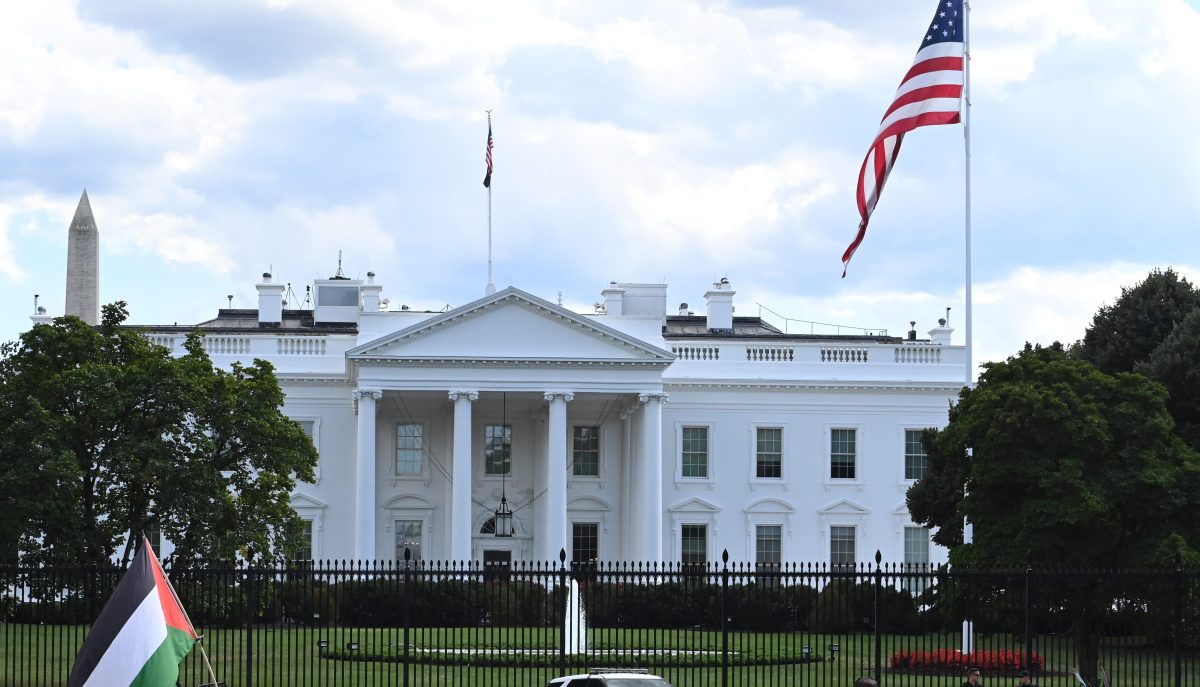
It’s the Butcher of Riyad. Tomorrow — Tuesday, Nov. 18, 2025 — Donald Trump will commit one of his most audacious assaults on decency when he breaks bread at the White House with Saudi Crown Prince Mohammed bin Salman, a man I like to call the Butcher of Riyad.
Trump commits an assault on decency simply by rising from his slumber each morning, but his insult against the moral universe tomorrow evening will be particularly egregious.
This man Mohammed is one of the world’s most bloodstained tyrants, but you would not know it from looking at the battalions of international celebrities who have murdered their consciences in order to accept millions of dollars of Saudi money. They are golfers, soccer players, Hollywood actors and actresses, comedians, singers. You name a profession, and I or someone else can show you the high-profile Westerners — and they need to be Westerners (most are Americans), and preferably white — who have been bought by Saudi Arabia to give the regime’s image the Persilschein.
Critics generally speak of “sports-washing” and “art-washing” being practiced by the Saudi government, but regardless of what a particular observer calls the practice, its aim is always the same: to draw the world’s eyes away from Saudi Arabia’s appalling human rights record and to give the kingdom a nice, acceptable global appearance.
The Saudi record of human rights violations is broad and bloody, but that record is particularly ugly in the area of the death penalty. To be clear, the Saudis are not the global leader in absolute number of executions by a national government in any given year; China is the champion there. Expert observers of the judicial system in China estimate that thousands of people are executed in that country annually. China does not, however, reveal the number of people its criminal justice system kills, so the expert observers can provide estimates only.
But Saudi Arabia, with a population of about 34 million vs. China’s 1.3 billion, is among the world’s busiest execution countries by its rate of official killing. And as a state run by a harsh and absolutist monarchy backed by a pitiless religious establishment, Saudi Arabia’s executions are very much the royal court’s affair to moderate or accelerate. Yes, I know that MBS is not yet king, but he is that in all but name; his father is 89 and ailing and is largely absent from the arena. King Salman is just quietly waiting for death to call his name. Thus MBS is large and in charge. And Trump certainly is sweet on him.
Many Saudis have lost their lives to the executioner’s sword or the firing squad so that MBS and the rest of the Saudi establishment — religious and secular — may live in their vision of tranquility without the nuisance of internal criticism or domestic political challenge.
This matter is addressed in a Human Rights Watch news release dated Aug. 11 of this year:
Saudi authorities have been carrying out an unprecedented surge in executions in 2025 without apparent due process, Human Rights Watch and the Middle East Democracy Center said today. The June 14 execution of Turki al-Jasser, a journalist known for exposing corruption within the Saudi royal family, raises concerns that the Saudi government is using the death penalty to crush peaceful dissent.
Saudi authorities had executed at least 241 people in 2025 as of August 5, with 22 executions in the previous week alone, according to the international human rights organization Reprieve. Reprieve reported that the number of executions in 2025 would exceed all prior records if executions continue at the same rate.
“Saudi authorities have weaponized the country’s justice system to carry out a terrifying number of executions in 2025,” said Joey Shea, researcher for Saudi Arabia and the United Arab Emirates at Human Rights Watch. “The surge in executions is just the latest evidence of the brutally autocratic rule of Crown Prince Mohammed bin Salman.”
By now you might be asking yourself: Wasn’t there some sort of international outrage in recent years concerning someone named Khashoggi? Yes, but let me give you a little history before we touch on the case that is tickling your brain. For people of my vintage and older, the name Khashoggi might more readily bring to mind someone from an earlier time. That would be Adnan Khashoggi, who died in London in 2017 at age 81. Adnan had been a Saudi insider of such sterling connections that in addition to being an international weapons dealer, he was a broker in many of the Saudi government’s military purchases on the world market. He was rich, he was influential, and he was cemented into the national and regional establishments. And so was his wider family, naturally.
Here is an example: Adnan Khoshoggi’s sister Samira married an Egyptian businessman known to the world as Mohamed al-Fayed. These two were the parents of a man named Dodi al-Fayed, who was romantically linked to Princess Diana and was fatally injured alongside her in that high-speed car crash in a road tunnel in Paris in August 1997.
Dodi al-Fayed had a cousin and Adnan Khashoggi a nephew by the name of Jamal Khashoggi.
Jamal Khashoggi was lured into the Saudi Consulate in Istanbul on Oct. 2, 2018, by Saudi security agents on the pretext that consular officials wished to finish up some paperwork he was seeking to be able to marry again. He was not seen to emerge from the consulate, and no trace of his body has ever been found, despite extensive searches in Turkey, including in forests, as part of the investigation that followed his disappearance. Investigations concluded that he had been murdered and his body dismembered inside the consulate. And the U.S. Central Intelligence Agency concluded that Mohammed bin Salman, the very guest for tomorrow’s White House dinner, had personally ordered that Khashoggi be killed.
Why was Jamal Khashoggi killed? He was a critic of the Saudi royal leadership who spoke up for human rights, including women’s rights, and argued for a system in Saudi Arabia that would more closely match Turkey’s, in which the religious establishment is far less dominant and secular society is far more in control and is more permissive. And Khashoggi laid out all of these views as a contributing columnist for The Washington Post. In other words, he was very public with his criticisms. That was enough to get him killed by a Saudi leadership that is malignantly averse to seeing its sharpest domestic critics continuing to draw breath.
The spectacular murder of Jamal Khashoggi happened about midway through the first Trump administration, but the heinous act barely disturbed the bromance between Trump and MBS. As we all know by now, Trump does not allow any pronouncements or assessments by U.S. intelligence agencies to disturb his plans. Whatever Trumpy wants to do, Trumpy gets to do.
And by now, in Trump’s mind, the ghastly business with Khashoggi at the consulate is old news, and possibly even fake news. The present is what matters. There’s his own ego to be burnished by a royal visitor no doubt bearing valuable gifts and copious praises; there’s a coldblooded authoritarian to be cozied up to; and the dagger that Trump has sunk deep into the heart of American decency is there to be given another savage twist.
But I have this to say to Trump: Before you and your butcher friend sit down to your fine meal tomorrow evening, you should know that hundreds of uninvited guests will be present. You and your friend the Butcher of Riyad might not see the unwelcome multitude standing shoulder to shoulder, hovering silently over you, your honored guest and all the others present for the feast, but they will be there as a standing accusation. I have to believe that if there will not be some sort of moral justice soon for you, your enablers and your guest the butcher, it will come one day. I leave you with this quote from the venerable Archbishop Desmond Tutu of South Africa:
“[T]he past … doesn’t go and lie down quietly and behave or disappear. It has this uncanny characteristic of returning to haunt us.”
 Democracy Warrior